How Solar Works
Solar doesn't have to be complicated. A residential solar system captures sunlight, converts it into electricity your home can use, and works alongside the electric grid to supply your home's energy needs.
Last updated 2026-08-19
Sunlight reaches the panels
Photons from the sun hit the solar panels on your roof.
Panels generate DC electricity
The panels convert that sunlight into direct current (DC) electricity.
Microinverters convert DC to AC
Each panel's microinverter turns the DC power into alternating current (AC) — the kind your home uses.
Your home uses the power
Available solar electricity powers your home first, before any grid power is drawn.
Extra power can go to the grid
When the system produces more than you're using, the extra can flow to the utility grid under applicable net-metering rules.
Grid fills the gaps
When the system isn't producing enough — like at night — your home draws electricity from the grid normally.
Battery optional
A battery (if installed) can store energy to use later, depending on how the system is designed.
Sunlight
hits the panels
Panels
generate DC power
Microinverters
DC → AC power
Your Home
uses AC power
Grid
stores credits / supplies
The parts of the system
Solar panels
The modules on the roof that turn sunlight into DC electricity.
Microinverters
Small inverters attached under each panel that convert DC to AC, panel by panel.
Electrical panel
Your home's breaker panel, where the solar AC power connects to your circuits.
Utility meter
The meter that measures power flowing in and out of your home. With solar it can spin backward when you send extra power to the grid, depending on your utility and rate.
Electric grid
The utility network that supplies your home when solar isn't enough and accepts your extra production when it is.
Solar monitoring
An app or portal that shows how much your system is producing, panel by panel.
Battery storage
An optional add-on that stores energy for later use, including during outages.
Does solar work when it's cloudy?
Yes, but at reduced output. Panels still generate electricity in cloudy weather — just less than on a clear day. Modern panels are designed to capture diffuse light, so your system keeps producing, just not at full capacity. On a heavily overcast day, production can drop significantly, and the grid simply supplies the difference.
What happens at night?
Panels don't produce solar electricity at night — there's no sunlight to convert. In a grid-connected system, your home simply pulls power from the utility grid as normal. During the day, any extra power you sent to the grid may have been banked as credits (per your utility's net-metering rules), which can offset what you pull at night. See Understanding Net Metering for how that works in NJ and PA.
What happens during a power outage?
Important
This is a common surprise. Grid-tied inverters are required to shut off when the grid goes down so they don't send power back onto lines that utility crews may be repairing. To keep some power during an outage, your system needs equipment specifically designed for backup — most often a battery with backup capability, or an inverter with islanding/backup features. A battery is not automatic protection though; it has to be configured for backup and sized for the loads you want to run. See Battery Storage for the details.
Next step
Want to see how a solar system could work on your home?
Upload your electric bill and request a free solar assessment.
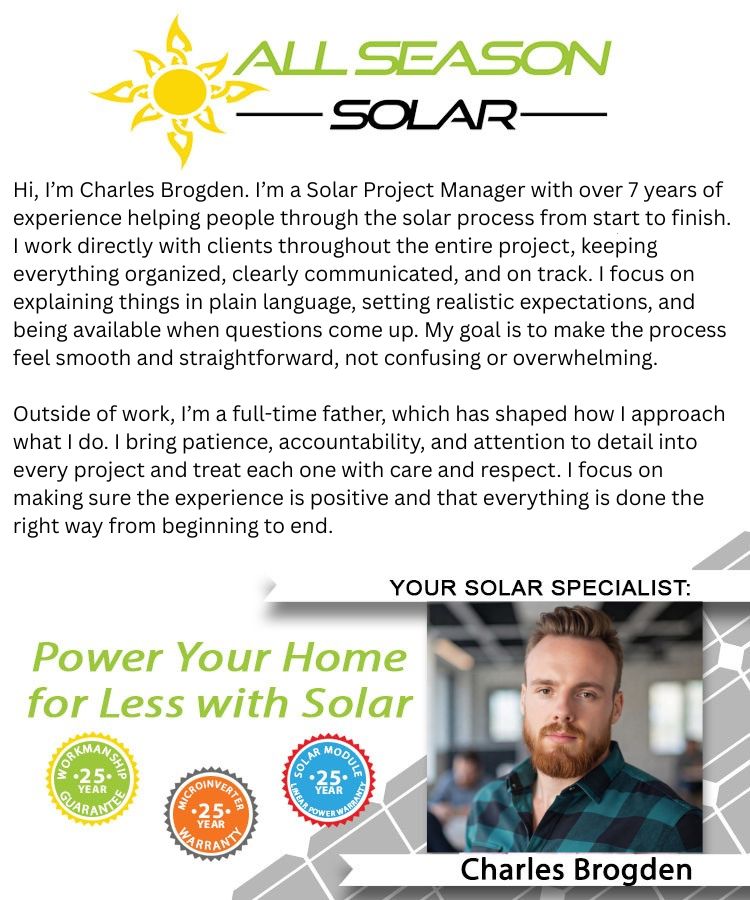
About Charles Brogden
Charles Brogden works directly with homeowners through AllSeason Solar & Roofing, helping customers understand solar system design, equipment, roofing considerations and available solar options.
Serving homeowners throughout New Jersey and Pennsylvania.