Microinverters vs. String Inverters
Before comparing the two, it helps to understand what an inverter actually does. Solar panels generate direct current (DC) electricity. Your home runs on alternating current (AC). The inverter is the device that converts one to the other.
Last updated 2026-08-19
There are two main approaches in residential solar. With microinverters, each panel has its own small inverter mounted underneath it. With a string inverter, multiple panels are wired together into one shared inverter, usually mounted on the side of the house.
Microinverters
Each panel has its own inverter. A shaded panel only slows itself — the rest keep producing.
String inverter
Panels run through one shared inverter. Shade on one panel can drag down the whole string.
How they compare
| Consideration | Microinverters | String inverters |
|---|---|---|
| Panel-level operation | Each panel works independently | Panels operate as a group (one string) |
| Shading | Only the shaded panel slows down | Shade on one panel can drag the whole string |
| System design | Flexible across multiple roof faces | Simpler on single, uniform roof faces |
| Monitoring | Panel-by-panel production visible | Total system production visible |
| Roof complexity | Handles multiple orientations well | Better suited to clean, uniform roofs |
| Equipment location | Under each panel (on roof) | Single unit, usually at the electrical area |
| Failure behavior | One inverter fails = one panel down | Central inverter failure = whole system down |
| Serviceability | Requires roof access to swap a unit | Central unit is easier to reach |
| Cost | Often higher upfront | Often lower upfront |
| Expansion | Easier to add panels later | Adding panels may require a larger inverter |
Where AllSeason commonly uses Enphase
AllSeason commonly installs Enphase microinverters, particularly IQ-series systems. The reasons are practical: panel-level monitoring makes it easy to see exactly what each panel is doing, and a single shaded or underperforming panel doesn't compromise the rest of the array. On roofs with multiple orientations, dormers, or partial shade — common across NJ and PA homes — that independence matters.
Not a universal superiority claim
Failure and serviceability
A microinverter failing means one panel drops offline; the rest keep producing, and your monitoring app shows exactly which one. Replacing it requires roof access. A central string inverter is easier to reach, but if it fails, the entire system stops producing until it's repaired or replaced.
Monitoring
Microinverter systems give you per-panel production data — useful for catching a single underperforming panel early. String systems show whole-array production. Both are helpful; the per-panel visibility just makes diagnostics easier.
Next step
Want to see how a solar system could work on your home?
Upload your electric bill and request a free solar assessment.
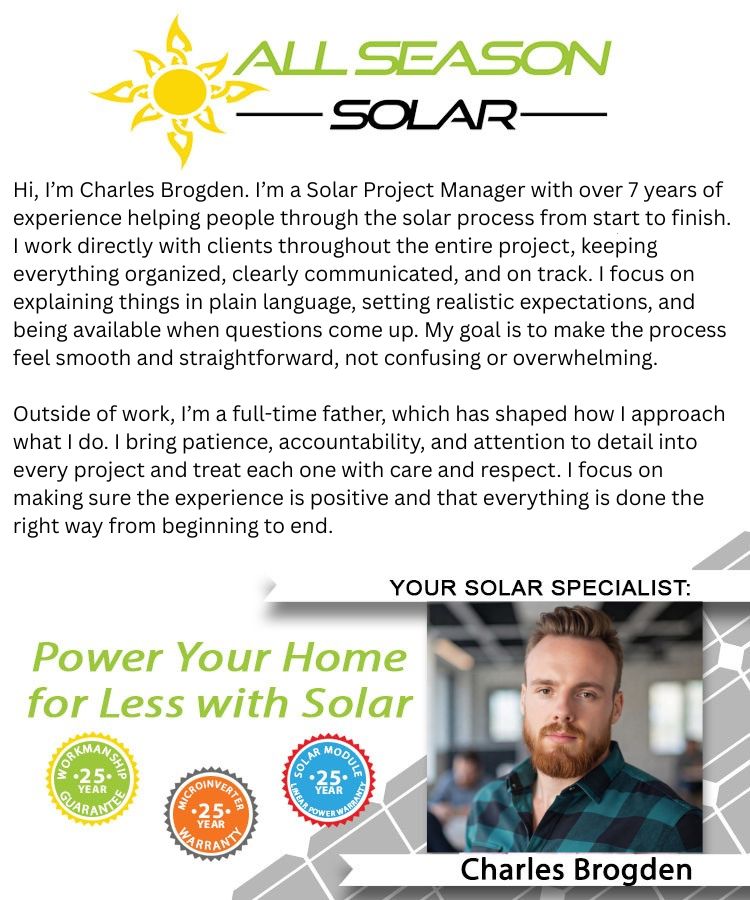
About Charles Brogden
Charles Brogden works directly with homeowners through AllSeason Solar & Roofing, helping customers understand solar system design, equipment, roofing considerations and available solar options.
Serving homeowners throughout New Jersey and Pennsylvania.