Solar Ownership vs. Leasing
There isn't one solar financing structure that's right for every homeowner. The important thing is understanding who owns the system, what you're responsible for, what benefits you may receive, and what happens over the life of the agreement.
Last updated 2026-08-19
Ownership vs lease at a glance
| Factor | Ownership (cash or loan) | Lease / PPA |
|---|---|---|
| Who owns the equipment | You do | The solar company does |
| Upfront cost | Cash: full price. Loan: $0 down typically | Usually $0 down |
| Monthly payments | Loan payment (if financed); none if cash | Fixed monthly or per-kWh payment |
| Available incentives | Generally flow to the owner | Usually retained by the leasing company |
| Maintenance | Generally your responsibility (warranty may cover parts) | Typically covered by the leasing company |
| Warranty | Manufacturer + installer warranties in your name | Lease terms usually include coverage |
| Selling the home | System is part of the sale | Lease may need to transfer or be bought out |
| Transfer considerations | Cleaner — owned asset transfers with property | Buyer must qualify to assume; otherwise buyout |
| Long-term cost | Lower total cost over the life of the system | Convenient, but typically higher total cost |
| Buyout options | N/A — you already own it | Often available at defined points or end of term |
Cash purchase
A cash purchase means you pay for the system outright and own it from day one. There's no monthly payment, and any available incentives — including the federal tax credit, where you qualify — generally flow to you. The trade-off is the upfront capital. For homeowners who have the cash and plan to stay in the home long enough to reach payback, ownership usually offers the lowest lifetime cost.
The tax credit and incentives belong to the owner, not the equipment
Questions to ask before signing any solar agreement
- What is the total system price?
- Who owns the equipment?
- Does the payment change over time?
- Is there an escalator (a preset annual increase)?
- What happens if I sell my home?
- Who receives the available incentives?
- Who is responsible for repairs?
- What warranty covers labor, not just parts?
- What happens at the end of the agreement?
- Can the system be purchased later, and on what terms?
Neither option is universally better
Next step
Not sure which option makes sense?
Send Charles your electric bill and compare the available options side-by-side.
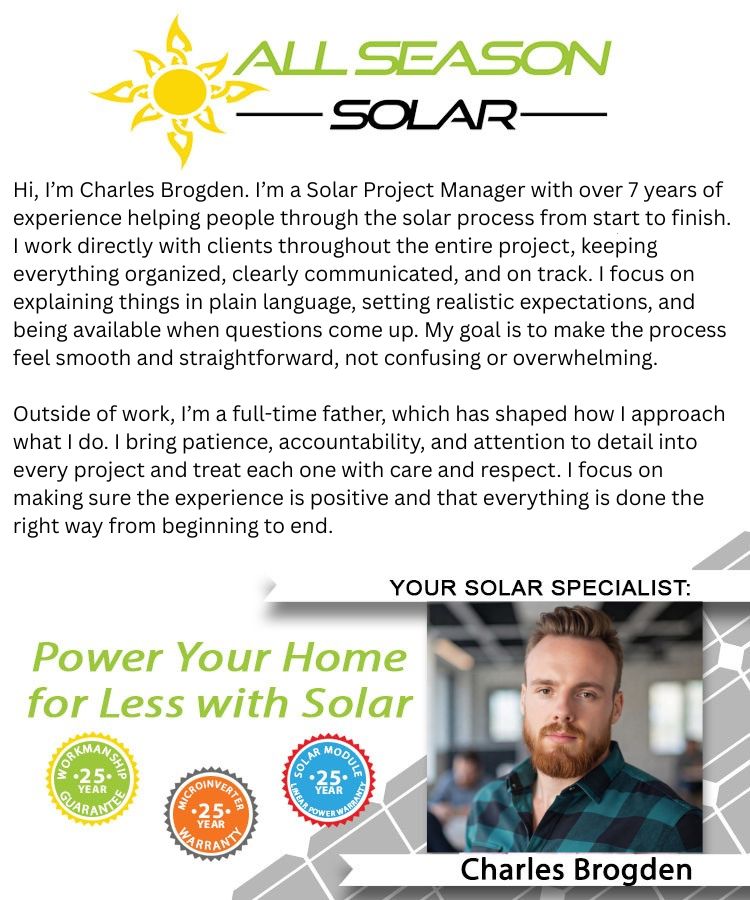
About Charles Brogden
Charles Brogden works directly with homeowners through AllSeason Solar & Roofing, helping customers understand solar system design, equipment, roofing considerations and available solar options.
Serving homeowners throughout New Jersey and Pennsylvania.